Our Research Focus Classes (RFC) are a special kind of lecture: they are more interactive and research-oriented than typical lectures. Students participating in an RFC should be aware that they are not only getting in touch with real research but also have to expect doing independent work. In the past, results from our RFCs have led to publications at high-ranking scientific venues and many participants continued to pursue their sparked passion for research within a PhD.
Please note: If you are interested in participating in the upcoming winter term, please drop us an email (rfc@comsys.rwth-aachen.de) and attach a few sentences stating your motivation of taking this course besides a current transcript of records.
Motivation
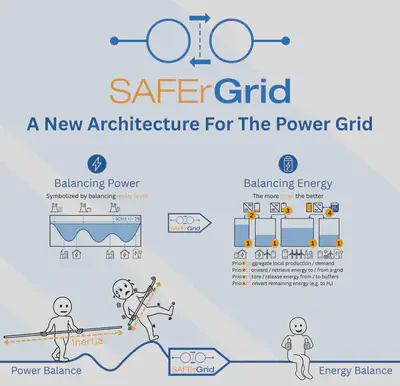
The global energy transition is rapidly transforming the structure of electrical power systems. Traditional grids were designed around a small number of large, controllable power plants that naturally stabilize the system to a system-wide frequency (50 Hz in Europe) through the physical inertia of rotating masses such as large turbines. In contrast, future energy systems will increasingly rely on millions of decentralized renewable sources such as solar and wind power, whose generation is inherently variable and connected through power electronics rather than rotating machines, thus providing no inertia. At the same time, electricity demand is growing and becoming less predictable due to the increasing electrification of sectors such as mobility, heating, and industry. Together, these developments push existing grid infrastructures toward their operational limits and increase the risk of instability and large-scale blackouts.
The research project SAFEr Grid aims to address these issues with a radically new energy grid architecture: Drawing inspiration from networks in the internet, the energy grid is imagined to consist of many asynchronous grids (a-grids) interfaced by energy routers that buffer and forward energy according to routing decisions. Together with the additional coordination of energy consumption flexibilities such as provided by electric vehicles, this concept aims to prevent cascading blackouts and to deal with the variability of renewable generation.
In this Research Focus Class (RFC), you will explore the intersection of distributed systems, communication networks, and modern power systems. Working in interdisciplinary teams, participants will investigate how concepts from computer networking, such as routing, layered architectures, and decentralized coordination, can be applied to the design of future energy infrastructures. The course combines discussions of foundational concepts with hands‑on experimentation using network simulation environments and prototypes of energy routers.
By developing and evaluating their own research ideas, students will gain experience in formulating research questions, conducting experiments, and analyzing complex cyber‑physical systems. The RFC offers a unique opportunity to engage with a cutting‑edge research topic at the interface of computer science and energy systems, while developing practical skills in collaborative research, experimental evaluation, and scientific communication.
Organizational Information
- Organizers: This course is offered in cooperation between COMSYS and the Institute of Automation of Complex Power Systems (ACS)
- Study programs: Master Informatik (Software und Kommunikation), Master Software Systems Engineering (Communication), Master Media Informatics, Master Data Science, Bachelor Informatik (nach Absprache as Vorzugsfach)
- Language: English
- Start: TBD, KW41
- Lecture slot: Doodled among participants
- Location: COMSYS, Building E3, Ahornstr. 55
- Due to limited capacity, prior registration is required!
- Registration and questions: Please send an email to rfc@comsys.rwth-aachen.de
Involved Partners
We are grateful for the support of our partners with a background in electrical engineering, who will provide a lecture on the technical fundamentals:
- Sebastian Schwarz: ACS, Chief Engineer / Team Energy Flexibility Management and Optimization)
Content
In this RFC, you will get in touch with coordination and optimization problems to operate an energy grid in a distributed fashion. Some examples include:
- The Current Situation of the Power Grid and a Radical New Paradigm
- Today’s electricity grid was designed more than a century ago based on physical inertia of generators. As renewable energy sources such as wind and solar replace these conventional generators, this stabilizing inertia is steadily disappearing. At the same time, millions of decentralized producers and increasingly flexible consumers are transforming the grid into a highly dynamic system. You will explore why these developments push the current grid architecture to its limits and investigate radically new ideas for operating future energy systems, such as decoupling the grid into asynchronous subgrids and routing energy between them in ways inspired by the architecture of the Internet.
- The Fundamentals of Power Systems
- To understand how future energy systems might work, we first need to understand how today’s grid operates. You will learn the essential principles of electrical power systems, including how power is generated, transmitted, and balanced across large geographical areas. Key concepts such as frequency stability, power flows, inverter-based renewable generation, and the role of power electronics will be introduced. These foundations will provide the necessary background to understand both the strengths and the limitations of current grid operation.
- Global Energy Routing, Flexibility Coordination and Large-Scale Simulations
- If the future grid becomes a network of interconnected subgrids, how can energy be efficiently routed to where it is needed? And how can millions of producers and consumers coordinate their behavior without centralized control? In this part of the course, you will explore mechanisms for coordinating flexible energy resources, designing routing strategies for energy flows, and studying system behavior through large-scale simulations. By experimenting with simulation tools and prototype systems, you will gain insights into how distributed coordination and communication could enable a scalable and resilient energy system of the future.
Structure
The RFCs are research-oriented courses following an interactive schema. To do so, we give a short introductory lecture about the topic (3-4 lecture slots). This lecture phase is accompanied by small practical homework tasks to familiarize yourself with the topic. Afterward in the analysis phase, you identify your own interesting research projects within the scope of the SAFEr Grid project (if necessary, we will help you with this) and prepare a short presentation of the motivation behind your idea and how you intend to tackle it. In the remainder of the class you then should realize your idea in the form of a mini project. The RFC concludes with a poster session where you will present your results. You will also have the opportunity to instead draft a paper, with the goal of submitting it to a workshop or conference.
Overall Schedule
- Lecture Phase: 2-3 weeks
- Getting up to speed!
- Learn about concepts, approaches, tools, examples …
- Hands-on supplementary homework tasks to practice what you learned
- Concept Phase: 2 weeks
- Based on that: Develop your own research idea
- Present and discuss your idea with the other participants
- Mini Project: up to 14 weeks
- Get your hands dirty! Perform work on your research idea
- Short presentation/demo at the end
- Interesting/fruitful projects may even result in a scientific publication
Prerequisites
This class will serve as an introduction on how to conduct research in the area of cyberphysical systems. Besides learning about the actual topics, taking this course is an ideal preparation for doing a master thesis in one of our groups and later on pursue a career in research. You should have prior knowledge at least in the basics of internet technology and an interest in doing independent research. A background in electrical engineering is not needed. As this course is supposed to be highly interactive, seats are limited. Should we receive more registrations than seats available, we will select students based on their qualification for this course.