COMSYS co-authors a Nature Reviews Article on Resilient Energy Grids
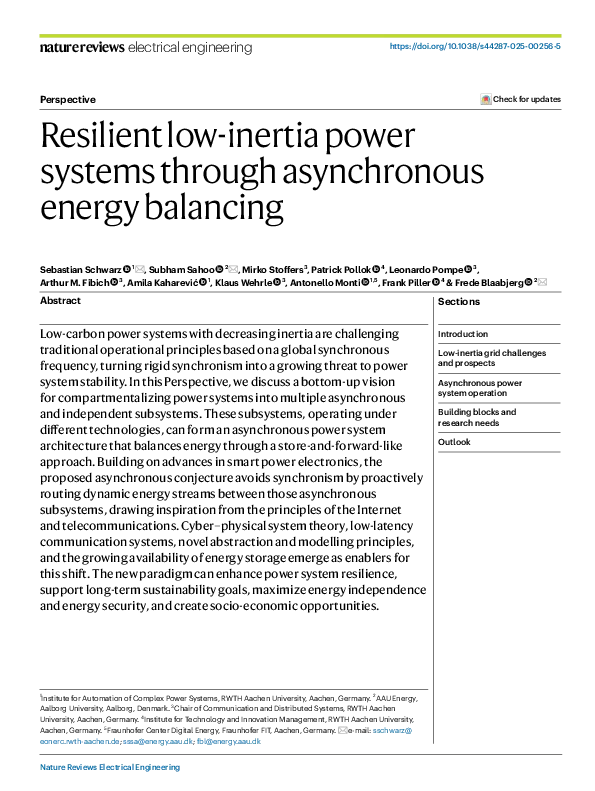
An interdisciplinary research team including COMSYS researchers working on the SAFEr Grid Project has published an article in the renowned journal Nature Reviews Electrical Engineering laying its foundation. On the authors list: Mirko Stoffers, Leonardo Pompe, Arthur M. Fibich and Prof. Dr.-Ing. Klaus Wehrle
An interdisciplinary research team from RWTH Aachen University and Aalborg University has published an article in the renowned journal Nature Reviews Electrical Engineering. In it, the researchers outline the fundamentals of how future power grids will function in order to make them resilient to outages and fit for volatile, sustainable energy sources. Both of these are key weaknesses in today’s energy supply. The work in Aachen and Aalborg is funded by the ERC Synergy Grant ‘Store-and-Forward Energy Grid (SAFEr Grid)’.
The energy transition is fundamentally changing electricity supply systems. While conventional power plants with large rotating masses have stabilised the power grid for decades, today an increasing proportion of energy comes from renewable sources such as wind and solar. These are volatile and lack the physical inertia that can dampen and stabilise minor fluctuations in the power grid.
Since electrification began in the 19th century, the electricity grid of a country or entire continent has formed a synchronous unit, which is stabilised by the dominant control principle of a consistently uniform grid frequency. Such synchronous regulation is particularly vulnerable to fluctuations and external influences. Security of supply is therefore facing new challenges. Serious grid disruptions, such as the blackout in Spain and Portugal in 2025 or the attack on the power supply in Berlin in early 2026, highlight the growing vulnerability of our power supply systems.
The internet as a model The scientists are promoting a fundamentally new approach: instead of viewing electricity grids as a fully synchronised system, they should be gradually transformed into smaller, autonomous but asynchronously coupled sub-grids. Energy would no longer be balanced via a common grid frequency. Instead, targeted energy exchange between the sub-grids would be possible based on modern power electronics and telecommunications solutions. The researchers draw an analogy with the architecture and operating principles of the internet, which also consists of millions of individual, asynchronously coupled local networks. Here, data packets are transported independently from router to router. This makes the overall system robust against large-scale disruptions.
This perspective does not imply a radical restructuring or expansion of existing electricity grids, but rather opens up a conceptual framework for their long-term and sustainable further development, which can be implemented step by step. Fluctuations in renewable energies are taken into account from the outset and flexibly balanced, while local disruptions are isolated. The system is thus no longer susceptible to large-scale outages – without the need for a massive expansion of grid capacity or the construction of numerous new fossil fuel power plants. It is precisely this inherent resilience that is considered a key prerequisite for a stable and climate-neutral energy system.
The perspective developed in the publication forms the scientific basis for the ERC Synergy Grant project SAFEr Grid, which is coordinated by RWTH Aachen University. In this innovative research project, researchers from RWTH Aachen University and Aalborg University are working to translate the theoretical concepts into robust models, novel control principles and real technical solutions and applications. The project is one of the most demanding funding lines of the European Research Council and was assessed in a peer review process as both visionary and realistic. The article now published confirms this assessment and shows a long-term viable path for a stable, secure and sustainable European energy supply.
To the publication: https://rdcu.be/eZUjq
More information about the Project: here, at EU CORDIS, at ACS, at AAU